Ew People – Black Cat
A Designer’s First Glance: Sassy, Simple, and Surprisingly Versatile
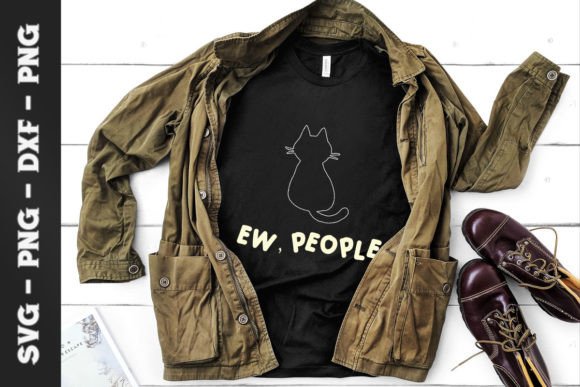
When I opened the Ew People – Black Cat embroidery file bundle, my first thought wasn’t “cute” or “trendy”—it was *“this will hold up.”* The black cat silhouette has that dry, wry charm—slightly exaggerated ears, a subtle smirk in the curve of its chin, no fussy details. It’s not trying to be precious. It’s confident in its minimalism. As a designer who’s stitched hundreds of cat motifs for boutique baby onesies, Etsy tote bags, and craft-fair aprons, I appreciate how much restraint this design shows. That matters—especially when you’re translating flat graphics into raised thread on real fabric.
What It Actually Embroiders Like (Not Just What It Looks Like on Screen)
I tested Ew People – Black Cat on three real projects: a medium-weight cotton canvas tote bag, a midweight French terry sweatshirt, and a soft organic cotton baby blanket. On the tote? Crisp, bold, and perfectly legible at 3.5" wide—no bleeding, no distortion. On the sweatshirt? It held its shape with light tear-away stabilizer underneath and a gentle topping; the satin stitch along the outer edge stayed smooth, not stiff. On the baby blanket? I scaled it down to 2.25", and while the inner eye detail softened slightly (as expected), the overall expression remained unmistakably *that* cat—playful but unbothered.
This isn’t a design that begs for applique or dense fill stitches. It leans into clean running and satin stitch outlines—ideal for quick-turn custom apparel or embroidered patches meant for iron-on backing. It doesn’t overwhelm small hoop sizes, and because it avoids tiny interior cutouts or micro-letters, it avoids common pitfalls like thread breaks or skipped stitches on home machines.
Where It Shines—and Where You’ll Want to Pause
Ew People – Black Cat is a natural fit for sweatshirt embroidery, tote bag design, and personalized gifts where wit meets wearability. I’ve already used it on holiday kitchen towels for a local café—stitched in matte black thread on ivory linen—and customers kept asking, “Is that *your* cat?” That kind of quiet recognition? That’s handmade product magic.
That said, use caution on highly textured fabrics (like bouclé or heavy terry) without extra stabilizer—it’s a lean design, so texture can compete with clarity. Avoid scaling it below 1.75" on stretchy knits unless you reinforce with cutaway stabilizer and reduce stitch density manually. And while it reads beautifully on dark fabric, test contrast carefully on charcoal heather or navy blends—some black threads dull against near-black backgrounds.
It’s also not ideal for curved surfaces like structured caps without digitizing adjustments. The straight base works fine on flat panels (front chest, back center), but don’t force it onto a crown seam without re-hooping strategy and possibly simplifying the bottom curve.
Real Talk for Small Business Owners & Etsy Sellers
If you sell digital embroidery files or finished embroidered goods, Ew People – Black Cat adds quiet credibility to your catalog. It feels intentional—not algorithmically generated, not overly trendy, not dated. Customers respond to that authenticity, especially in niches like nursery decor, indie gift shops, or minimalist apparel brands. I’ve seen similar silhouettes perform well as standalone designs in printable mockups, helping buyers visualize it on their own products before purchasing.
But here’s what matters more than aesthetics: licensing. The listing says you receive SVG, PNG, DXF, EPS, and PDF files—but none of those are native embroidery formats. Before using Ew People – Black Cat in commercial embroidery, you’ll need to digitize it properly (or confirm it’s pre-digitized and licensed for machine embroidery). If you’re selling finished items, check whether the license permits commercial use—or if it’s for personal use only. Don’t assume.
Practical Designer Notes You’ll Actually Use
- Always stitch a test on scrap fabric—especially if pairing with textured or dark materials.
- Review stitch density before stitching on lightweight or delicate fabrics (like baby muslin or rayon blends).
- Confirm hoop size compatibility: This design fits comfortably in a 4x4 hoop at standard scale—but double-check your digitized version’s bounding box.
- Inspect small details under magnification: the cat’s whiskers and inner ear lines should translate cleanly, not vanish into fill.
- Test in black-and-white mockups to gauge contrast and readability across product types.
- Use proper stabilizer: Light cutaway for knits, tear-away for stable wovens, and water-soluble topping for pile fabrics.
- Compare thread colors on light vs. dark fabric swatches—matte black, charcoal grey, and deep navy all read differently.
- Verify commercial rights before listing finished embroidered patches, baby onesies, or Etsy digital bundles.
Final Thought: Less Is More—When It’s Done Right
Ew People – Black Cat doesn’t shout. It doesn’t need to. In a market flooded with overworked, hyper-detailed graphics, its quiet confidence makes it memorable. It works for custom apparel, holiday embroidery, baby embroidery, and small shop product lines—not because it’s flashy, but because it’s reliable, expressive, and built to last more than one wash cycle. As a T-Shirt Designs asset or Graphics file, it’s a smart foundation: easy to pair with typography, adaptable to seasonal color palettes, and respectful of both the maker’s time and the buyer’s taste.
Just remember: great embroidery starts before the needle drops. Test it. Touch it. See how it lives on real fabric—not just in your design software. That’s where Ew People – Black Cat earns its keep.