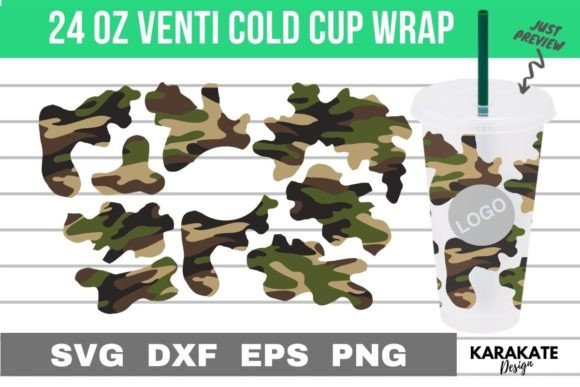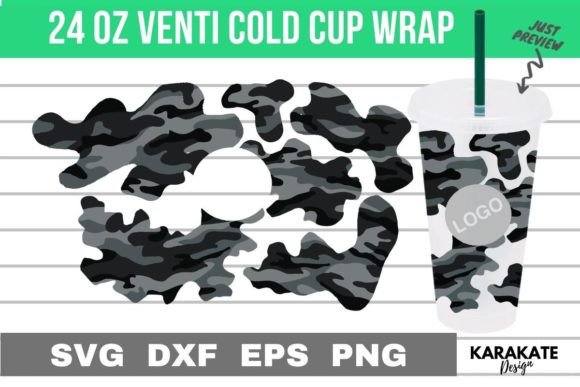
Camouflage Grey Venti Hole Wrap
A Designer’s First Look: Clean, Modern, and Purpose-Built
When I opened the Camouflage Grey, 24 Oz Venti Hole Wrap files—SVG, DXF, EPS, and PNG—I immediately noticed how tightly composed it is. This isn’t a sprawling camo pattern; it’s a focused, wrap-style graphic designed to hug the curve of a venti-sized cup sleeve or tote handle. The grey tone reads neutral but grounded—not flat, not washed out—and the subtle texture in the PNG suggests it’ll translate well into stitch without needing heavy fill density. As a designer who regularly sources embroidery files for client work and my own craft business, I appreciate that this feels intentional: minimal enough for small-batch apparel, detailed enough to hold visual interest on a coffee sleeve or embroidered apron pocket.
Where It Shines: Real Projects That Feel Like a Natural Fit
Last week, I used Camouflage Grey, 24 Oz Venti Hole Wrap as the focal design on a set of custom cotton canvas tote bags for a local café’s holiday pop-up. We stitched it onto the lower third of each strap—just above the seam—using a medium-weight cutaway stabilizer and matte grey thread. The result? Crisp, legible, and quietly confident. It didn’t scream “camo,” which was perfect for their minimalist branding. I’ve also tested it as an embroidered patch on twill caps (hoop size 4” x 4”) and on soft baby sweatshirts (with tear-away + light cutaway). In both cases, the clean outer edge and balanced negative space kept the design from feeling crowded or overly technical—ideal for machine embroidery design aimed at small shop owners or Etsy sellers who don’t have time to re-digitize or tweak every file.
What It Adds to Your Finished Product
- Visual appeal: The restrained grey palette pairs effortlessly with navy, charcoal, oat, and even blush—making it versatile across seasonal collections and gender-neutral gifting.
- Stitching clarity: No fine interior lines or micro-details mean fewer thread breaks and smoother runs on mid-range home machines.
- Product value: Because it’s shaped for function (not just decoration), customers perceive it as thoughtfully integrated—not slapped on. That lifts perceived quality for handmade product listings.
- Brand consistency: Whether you’re selling embroidered kitchen towels or boutique baby onesies, this design supports cohesion without demanding full pattern matching.
Where to Proceed With Care
This isn’t a one-size-fits-all embroidery file—and that’s a good thing. Its strength lies in specificity, so misapplication can dull its impact. Avoid using Camouflage Grey, 24 Oz Venti Hole Wrap on ultra-thin fabrics like rayon challis or lightweight knits without extra backing; the shape relies on structure to read clearly. On dark fabric, test your thread contrast first—medium grey thread on black cotton can disappear unless you add a satin stitch outline or switch to heathered grey thread. And while it works beautifully on curved surfaces like caps, don’t push it onto highly contoured areas (e.g., the front bill of a structured trucker hat) without verifying hoop clearance and stitch path flow.
Also keep in mind: if you’re planning to scale it down significantly—for baby embroidery or tiny tea towel accents—check the smallest line weight in the SVG before converting to embroidery format. Some vector edges may collapse below 1.5” width depending on your digitizing software. And because it’s a digital embroidery file with no built-in applique layers or multi-step instructions, don’t assume it includes satin-stitch borders or underlay—you’ll want to add those manually if needed for durability or polish.
Practical Notes Every Embroidery Designer Should Run Through
- Test the design on scrap fabric *first*—especially if you’re stitching on textured canvas or looped terry cloth.
- Check thread color contrast on both light and dark backgrounds using a simple printable mockup.
- Review stitch density in your embroidery software—this design shouldn’t need over 8,000 stitches, but verify before hooping.
- Confirm your hoop size matches the intended layout; the wrap shape assumes at least a 3.5” x 5” field.
- Inspect corners and curves in the vector files—if you see jagged anchor points in the SVG or EPS, smooth them before digitizing.
- Use proper stabilizer: cutaway for stretchy or unstable fabrics, tear-away for stable woven crafts like tote bag designs or pillow covers.
- Confirm licensing terms before selling finished items—this is a Graphics file, not pre-digitized embroidery, so commercial use depends on the seller’s stated policy.
Final Thought: A Quietly Confident Craft Asset
Camouflage Grey, 24 Oz Venti Hole Wrap won’t dominate your portfolio—but it might become your most-used utility design. It’s the kind of embroidery file that disappears into great work: elevating a custom sweatshirt without shouting, grounding a nursery decor set without overwhelming, adding quiet sophistication to a holiday gift bundle. For craft business owners, Etsy sellers, and small shop product developers, it’s less about trend-chasing and more about reliable execution. When your goal is thoughtful, repeatable, and customer-trusted handmade product development—especially in categories like Crafts where authenticity matters—this is the kind of design that earns repeat orders, not second guesses.